
Using real building performance to specify better domestic air source heat pumps
This is a practical Net Zero Gurus article explaining Heat Transfer Coefficient, why it matters, and how it supports more accurate ASHP specification under a whole-house retrofit approach by using HTC-Led Heat Pump Design.
At Net Zero Gurus, HTC-Led Heat Pump Design is about getting domestic air source heat pump specification closer to how the home actually performs, not just how a model assumes it performs. When an ASHP is sized from better evidence, the result is a warmer home, less risk for the client, fewer call-backs for installers, and a stronger compliance position for projects delivered under PAS 2035 and funded retrofit schemes.
Why HTC-Led Heat Pump Design Matters
Heat pump sizing is one of the most important parts of any low carbon heating project. If the heat pump is too large, it can short cycle, run inefficiently and cost more than it should. If it is too small, the occupier may experience cold rooms, slow recovery times and a loss of confidence in the installation.
This is where HTC-Led Heat Pump Design becomes useful. It provides a clear link between the building’s heat loss and the required heating output. Instead of relying only on assumptions, it helps the design team understand the level of heat the property is likely to need at design conditions.
What is Heat Transfer Coefficient?
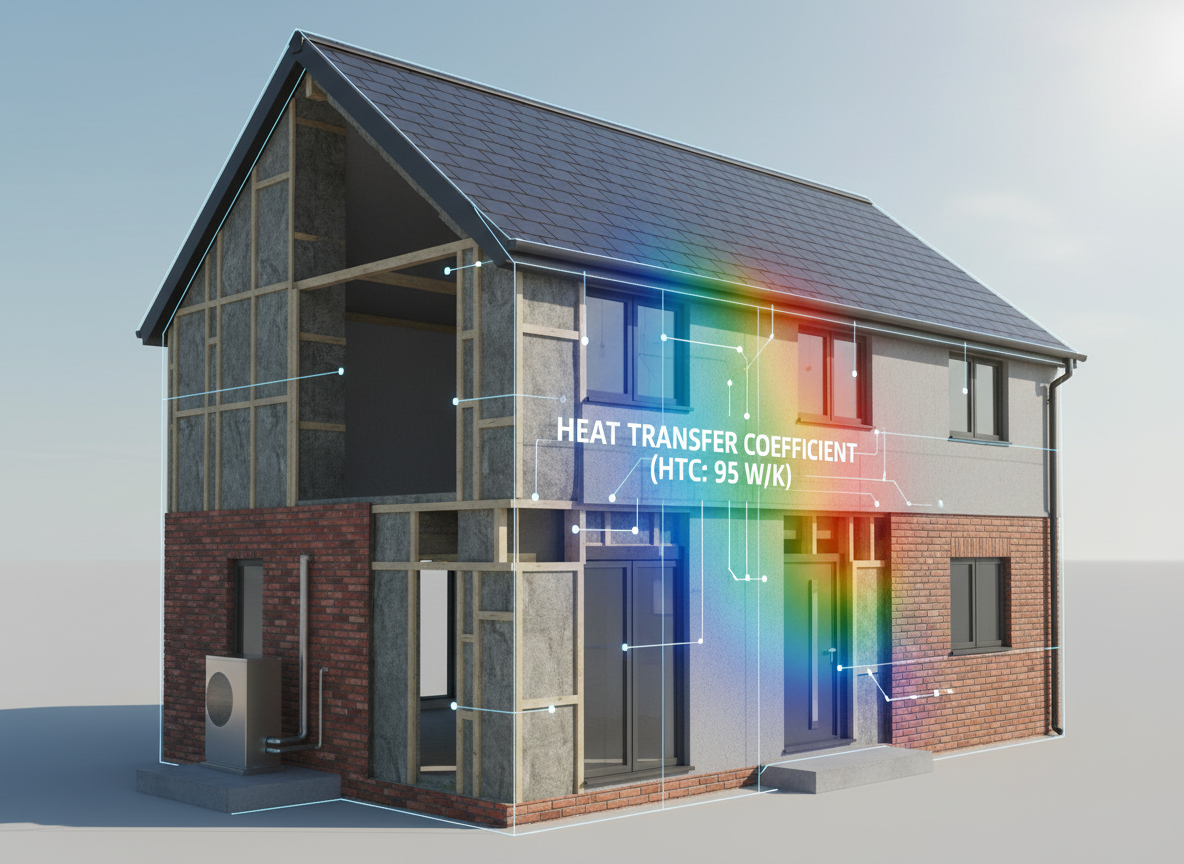
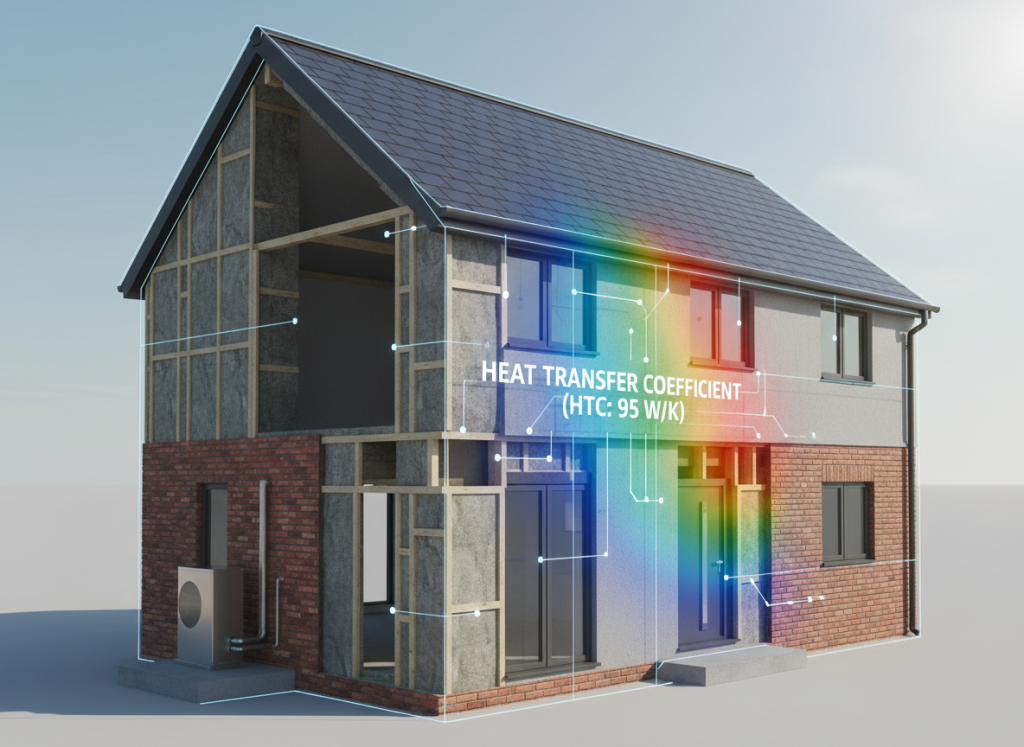
Heat Transfer Coefficient, often shortened to HTC, is a whole-house measure of heat loss. It shows how many watts of heat are lost for every 1°C temperature difference between inside and outside. It is usually expressed as W/K.
For example, if a home has an HTC of 100 W/K, it needs around 100 watts of steady heat input to maintain a 1°C difference between the inside and outside temperature. With a 21°C difference, that would equate to around 2.1 kW of heat demand.
- Fabric heat loss: walls, floors, roofs, windows and doors.
- Ventilation heat loss: planned ventilation as part of the property strategy.
- Infiltration: uncontrolled air movement through gaps and leakage paths.
- Thermal bridging: areas where heat escapes more readily through junctions or details.
HTC-Led Heat Pump Design and Real Homes
A room-by-room heat loss calculation still has an important role. It supports radiator sizing, emitter design, flow temperature decisions and comfort checks in individual rooms. The problem is that the whole project can still be weakened if the starting assumptions are not accurate.
Real homes do not always behave like neat drawings. Construction details can be uncertain. Existing insulation may not perform as expected. Air leakage may be higher than assumed. Occupier behaviour, ventilation and workmanship can all affect performance. HTC-Led Heat Pump Design helps bring the discussion back to the building as a complete system.
Plain English explanation
HTC is the building’s heat loss fingerprint. The lower the figure, the less heat the building loses and the easier it is for a heat pump to operate efficiently.
How HTC Helps Size an ASHP
The basic principle is simple:
Heat demand (W) = HTC × temperature difference
Once the HTC is known or better understood, the designer can apply the relevant design temperature difference to estimate the peak heat demand. This supports a more informed selection of ASHP capacity, emitter requirements and likely operating temperatures.
For Net Zero Gurus, HTC-Led Heat Pump Design does not replace good retrofit assessment, design judgement or PAS 2035 coordination. It strengthens them. It provides another evidence point that helps reduce the risk of oversizing, undersizing or specifying a system that does not suit the property.
Benefits of HTC-Led Heat Pump Design
| Benefit | Why it matters |
| More accurate sizing | Links the building’s heat loss directly to heating demand, helping the designer avoid generic assumptions. |
| Lower running costs | A correctly sized system is more likely to run steadily and efficiently, supporting better seasonal performance. |
| Better comfort | Comfort is improved when the system can meet demand without excessive cycling or poor room recovery. |
| Reduced call-backs | Fewer sizing errors means fewer complaints, fewer revisits and less disruption for clients and occupiers. |
| Stronger compliance story | It supports a clear audit trail showing how performance, risk and design decisions were considered. |
Where Knauf Fits In
Knauf Energy Solutions has published information on deriving HTC from house heat energy models. Their work is useful because it adds to the wider industry move towards comparing modelled performance with real or outputs-based performance. It also supports the idea that buildings should be assessed as complete systems, not just a list of isolated measures.
You can read the Knauf reference here: HTC-Led Heat Pump Design.
Why This Helps Net Zero Gurus Stand Out
Net Zero Gurus works across energy consultation, retrofit coordination, retrofit design, compliance support and quality monitoring. That means we are not just interested in whether a measure can be installed. We are interested in whether the measure is right for the home, right for the occupier and right for the funding and compliance route.
By using HTC-Led Heat Pump Design as part of our thinking, we can support better ASHP specification by looking at the property as a whole. This aligns with the way retrofit should be delivered: assess properly, design properly, manage risk properly and keep evidence clear enough to withstand scrutiny.
- More robust heat pump specifications for domestic retrofit projects.
- Better advice to installers, councils, housing providers and delivery partners.
- Clearer conversations around fabric improvement before low carbon heating.
- More practical decisions on whether ASHP is suitable now or after enabling works.
- A stronger link between technical design, resident comfort and long-term performance.
HTC-Led Heat Pump Design Under a Whole-House Approach
PAS 2035 is built around whole-house thinking. Insulation, ventilation, heating, moisture risk and occupant needs all interact. A heat pump should not be treated as a stand-alone product. It is part of a wider domestic energy system.
That is why HTC-Led Heat Pump Design is so valuable. It helps connect building fabric performance with heating system design. It also supports better sequencing by showing when fabric improvements may be needed before a heat pump is specified.
My Final Thoughts
Heat pumps can work extremely well in domestic properties, but the design has to be right. The industry needs to move away from broad assumptions and towards evidence-led specification that reflects how homes really perform.
HTC-Led Heat Pump Design gives Net Zero Gurus another practical way to reduce risk, improve comfort, support compliant retrofit delivery and help clients make better decisions when specifying domestic ASHP systems.
Reference Links
- Net Zero Gurus Retrofit Designs
- Knauf Energy Solutions: A Method for Derivation of HTC from House Heat Energy Models
Author
Andrew Foote
CEO: Net Zero Gurus