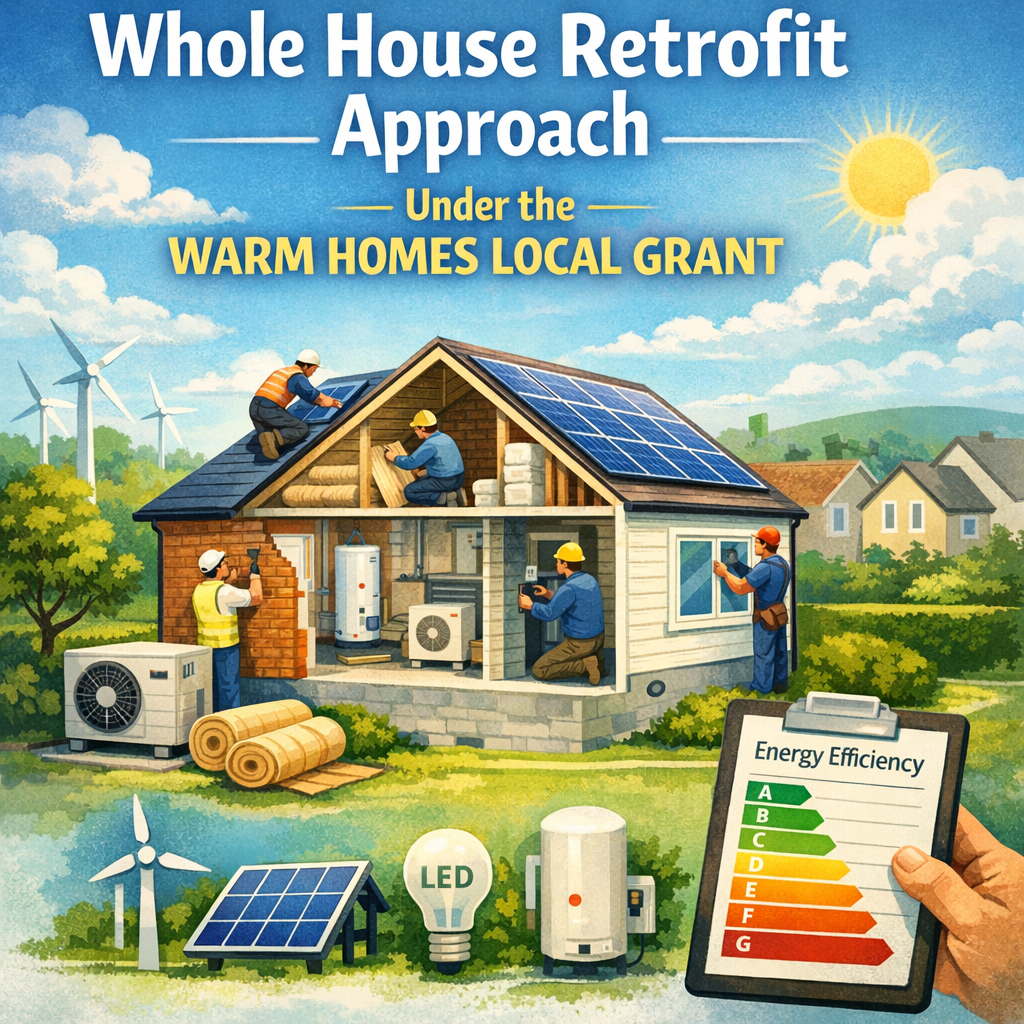
Whole house retrofit approach for Warm Homes Local Grant are not intended to be isolated or piecemeal improvements. Instead, they are planned and delivered using a whole house retrofit approach, which recognises that a dwelling functions as an integrated system, rather than as a collection of independent elements.
This approach considers how the building fabric, heating system, ventilation, and occupant use interact to influence overall performance. The fundamental objective is to deliver measurable and sustained improvements in energy efficiency, thermal comfort, and household affordability, while minimising the risk of unintended consequences, such as condensation, damp, overheating, or reduced indoor air quality.
Retrofit interventions are therefore sequenced and combined, in line with PAS 2035 retrofit planning principles, to achieve the following core outcomes.
1. Reduce Heat Loss (Fabric Efficiency)
The priority under the Warm Homes Local Grant whole house retrofit approach is to reduce the amount of heat required to maintain comfortable internal temperatures. This is achieved through targeted improvements to the building fabric, including wall, loft/roof insulation, alongside appropriate airtightness measures.
Reducing fabric heat loss:
- Lowers overall space heating demand
- Improves thermal comfort and temperature stability
- Establishes a suitable baseline for efficient heating system operation
This step is essential to ensure that any subsequent heating system upgrades operate effectively and efficiently, and that systems are not oversized.
2. Improve Heating System Efficiency
Once heat demand has been reduced, the focus shifts to how efficiently heat is generated, controlled, and distributed within the home.
This may involve:
- Upgrading to low carbon heating systems, such as heat pumps, where the property is suitable; or
- Optimising existing heating systems through improved controls, zoning, system balancing, and heat distribution, where full replacement is not appropriate.
Heating systems perform best in homes with reduced heat loss, enabling lower flow temperatures, improved comfort, and enhanced overall system efficiency.
3. Lower Energy Bills and Carbon Emissions Over the Long Term
By addressing fabric performance and heating efficiency together, households benefit from sustained reductions in energy consumption, rather than short‑term gains that may diminish over time.
This integrated approach supports:
- Long term reductions in energy bills
- Improved SAP and EPC ratings
- Lower operational carbon emissions
These benefits are resilient to future changes in energy prices and directly support national decarbonisation objectives.
SAP Focused Measures in Correct Installation Order
Warm Homes Local Grant upgrades are delivered using a planned and sequenced retrofit approach, ensuring that early measures reduce heat demand and prepare the dwelling for higher impact interventions installed later. Installing measures out of sequence can reduce SAP uplift, increase overall costs, or introduce building performance risks.
The following sequence represents best practice installation order, aligned with PAS 2035 whole house retrofit principles, while achieving the highest possible SAP rating improvement.
1. Loft and Roof Insulation
Priority: reduce heat demand
Fabric improvements form the starting point for most retrofit projects. Improving roof and loft insulation reduces heat loss, stabilises internal temperatures, and provides a strong foundation for all subsequent measures.
Typical works include:
- Topping up loft insulation to 270- 300 mm
- Insulating loft hatches and service penetrations
- Insulating flat roofs where applicable
Why this comes first
- Low disruption and low technical risk
- Immediate reduction in space heating demand
- Improves the performance and sizing of future heating systems
2. Wall Insulation (Cavity or Solid Wall)
Second priority: address the largest heat loss area
Once roof heat losses have been reduced, retrofit interventions focus on walls, which typically represent the largest source of fabric heat loss.
Measures may include:
- Cavity wall insulation (where suitable)
- External wall insulation (EWI)
- Internal wall insulation (IWI)
Why this comes early
- Significantly reduces space heating demand
- Enables smaller, more efficient heating system design
- Delivers substantial SAP improvements, commonly 8-15 points
All wall insulation measures are assessed, designed, and installed to manage moisture and condensation risk in line with PAS 2035 risk pathways.
3. Heating Controls and System Optimisation
(Where a heat pump is not yet being installed)
Before replacing heating systems, existing systems should be optimised to operate as efficiently as possible.
Typical upgrades include:
- Programmable or smart thermostats
- Thermostatic radiator valves (TRVs)
- Zoned heating controls
- System balancing and optimisation
Why controls come before system replacement
- Reduces wasted heat and improves user control
- Delivers SAP uplift at relatively low cost
- Can reduce or defer the scale of later heating upgrades
This stage represents a high value intervention and helps avoid unnecessary heating system oversizing.
4. Low‑Carbon Air Source Heat pumps
Fourth priority: decarbonise heat once demand is reduced
After fabric and system optimisation measures have been completed, homes are better suited to low carbon heating systems, such as air source heat pumps.
Why heat pumps are installed later
- System performance depends on low heat demand
- Smaller systems can be specified more cost effectively
- SAP uplift is maximised only after fabric improvements
Air Source Heat pumps work particularly well with Solar PV and Battery Storage
Heat pumps are electrically powered systems and therefore integrate effectively with on site renewable electricity generation. When combined with solar PV, a proportion of the electricity required to operate the heat pump can be generated directly on site, reducing reliance on imported grid electricity.
The addition of battery storage further enhances system performance by:
- Storing surplus solar electricity generated during the day
- Allowing stored energy to be used to power the heat pump during evenings or periods of low solar generation
- Increasing on‑site energy self consumption, which improves household energy affordability
From a SAP perspective, this combination:
- Reduces calculated purchased electricity
- Improves dwelling emission rates
- Strengthens EPC outcomes, particularly when heat pumps and PV are assessed together
When correctly sequenced, heat pump installations can deliver SAP increases of 10- 25 points, often representing the single largest improvement under Warm Homes Local Grant funding.
5. Solar Photovoltaic (PV) Panels and Battery Storage
Final step: reduce energy demand and support electric heating
Solar PV systems in a whole house retrofit are typically installed toward the end of the retrofit process, once the dwelling’s energy demand profile and heating system configuration are better understood.
Measures may include
- Roof‑mounted solar PV system (e.g. 3- 4 kWp)
- Domestic battery storage system to retain excess generation
Why PV and battery storage come last
- They complement electric and low carbon heating systems, such as heat pumps
- They reduce calculated purchased energy within SAP assessments
- Battery storage increases the proportion of generated energy used within the home
Technical benefits of pairing PV with battery storage
- Surplus daytime generation can be stored rather than exported
- Stored electricity can be used to support heating, hot water, and household loads
- Reduces exposure to peak electricity tariffs
- Improves resilience to future energy price volatility
Installed at this stage, solar PV combined with battery storage can deliver SAP improvements of 5-12 points, while acting as the final optimiser that supports progression to higher EPC bands, often enabling C → B outcomes.
Why This Sequencing Matters
Delivering measures in the correct order ensures that:
- SAP improvements are maximised and sustained
- Heating systems are correctly sized and operate efficiently
- Risks related to moisture, ventilation, and overheating are managed
- Public funding delivers robust, long term value
This fabric first, system second approach is central to Warm Homes Local Grant delivery and reflects both technical best practice and full PAS 2035 compliance.
Typical EPC Band Movement
One of the key performance indicators for Warm Homes Local Grant delivery is improvement in EPC band, which is directly linked to increases in the property’s SAP score. While outcomes vary depending on starting condition and property type, a sequenced whole house retrofit approach is designed to enable step change improvements, rather than marginal gains.
The examples below illustrate typical EPC band movements seen when SAP focused measures are installed in the correct order.
A Worked Example:
Fabric → Heat Pump → Solar PV, Battery
Property Profile (Before Retrofit)
- Property type: 1930s semi detached house
- Construction: Solid walls, uninsulated loft
- Heating: Gas boiler, basic controls
- Starting EPC band: E (SAP ~45)
- Key issues: High heat loss, high running costs, poor thermal comfort
Stage 1: Loft and Wall Insulation
Measures installed
- Loft insulation top‑up to 300 mm
- External or internal wall insulation to solid walls
- Associated airtightness improvements
Technical impact
- Significant reduction in fabric heat loss
- Lower space heating demand
- Improved internal temperature stability
SAP / EPC outcome
- Typical SAP increase: +15 to +20 points
- EPC movement:
E (45) → D / low C (60- 65)
Why this stage matters This stage creates the thermal baseline needed for efficient low carbon heating. Without these fabric improvements, later measures would be less effective and more costly.
Stage 2: Low Carbon Heating System (Heat Pump)
Measures installed
- Air‑source heat pump
- Upgraded radiators where required
- Improved heating controls and zoning
- (Where applicable) preparation for integration with on site renewable electricity and battery storage
Technical impact
- Replacement of fossil‑fuel heating with low‑carbon technology
- Much higher system efficiency (SCOP >3)
- Significantly lower carbon intensity, strongly rewarded within SAP
- Electrification of heat, enabling effective integration with solar PV and battery storage
SAP / EPC outcome
- Typical SAP increase: +10 to +20 points
- EPC movement:
D / C → solid C or low B (SAP 70- 80)
Why this stage follows insulation
With heat demand already reduced through fabric improvements, the heat pump can:
- Operate at lower flow temperatures
- Be correctly sized (smaller and cheaper to install and run)
- Deliver maximum SAP uplift
- Operate more effectively alongside solar PV and battery storage, reducing reliance on grid electricity
This sequencing ensures both technical performance and cost effectiveness are optimised.
Stage 3: Solar Photovoltaic (PV) Panels and Battery Storage
Measures installed
- Roof mounted solar PV system (e.g. 3–4 kWp)
- Domestic battery storage system
Technical impact
- Reduction in calculated purchased electricity within SAP
- Strong interaction with electric heating systems, particularly heat pumps
- Battery storage enables surplus solar electricity generated during the day to be stored and used later
- Stored energy can support heat pump operation, hot water production, and household loads during evening or peak tariff periods
- Increased on site energy self consumption improves household resilience to energy price volatility
SAP / EPC outcome
- Typical SAP increase: +5 to +12 points
- EPC movement:
C → B (or strengthening an existing B rating)
Final EPC position
✅ E → C → B, achieved through a sequenced whole house retrofit approach
Summary of EPC Band Movement
| Retrofit Stage | Typical EPC Band |
| Before works | E |
| Loft & wall insulation | D / low C |
| Heat pump installed | Strong C / low B |
| Solar PV + battery added | B |
Why This Example Matters for Warm Homes
This example demonstrates that:
- Fabric first measures unlock later system improvements
- Heat pumps deliver maximum SAP benefit only after insulation
- Solar PV combined with battery storage acts as a final optimiser, improving SAP outcomes and supporting progression to higher EPC bands
Crucially, no single measure achieves this outcome alone. The combined, sequenced package delivers:
- Long term energy bill reductions
- Significant carbon savings
- Robust, defensible SAP and EPC improvements
- Improved household resilience to future energy price changes
This is why the Warm Homes Local Grant focuses on coordinated, whole house retrofit solutions, rather than isolated upgrades.