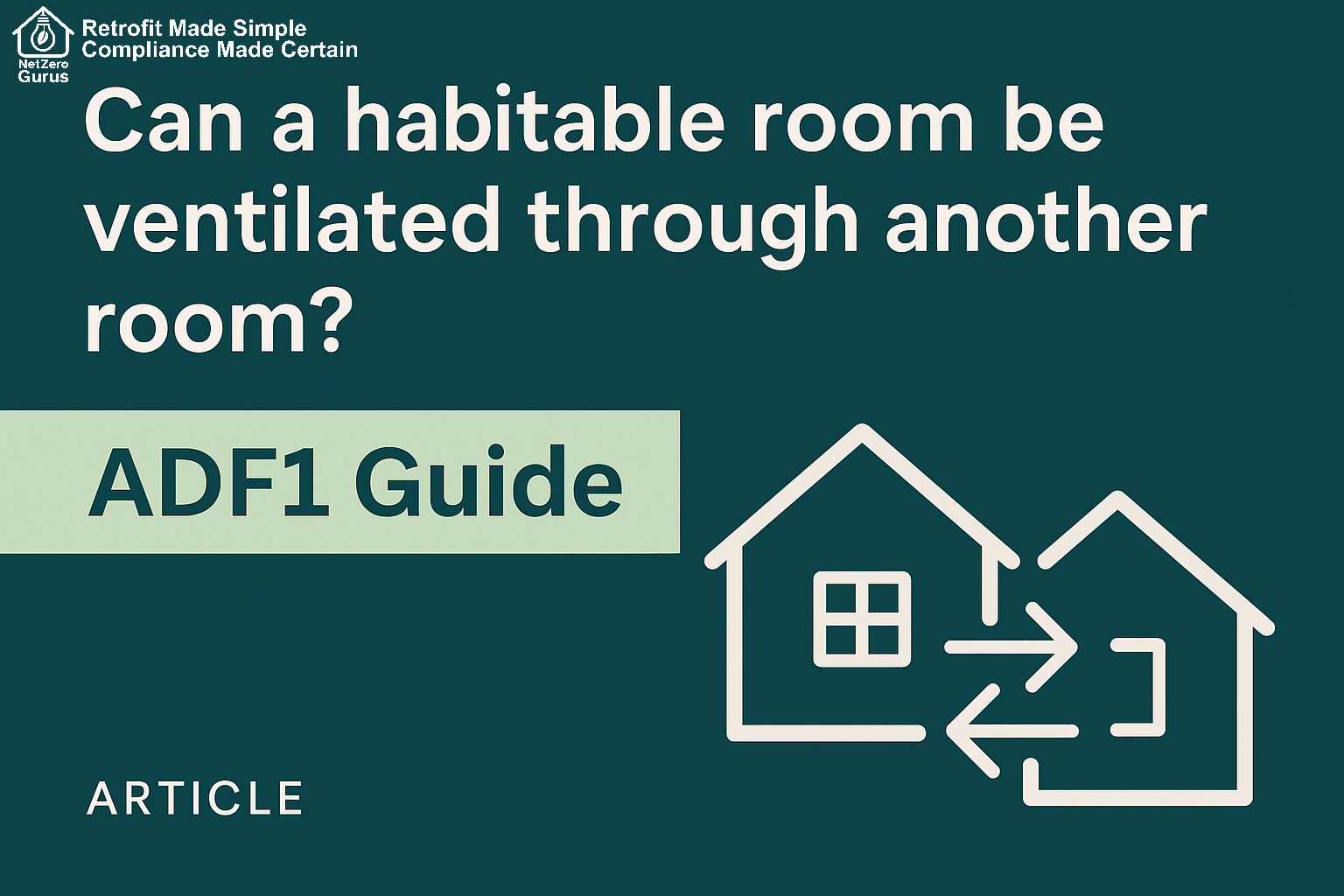
Ventilation through another room — sometimes called borrowed ventilation — is a common reality in retrofits, extensions, loft conversions, and older homes where internal layouts have changed over time. When an inner room has no external window, the Building Regulations, specifically Approved Document F (ADF1), provide a set of rules to ensure safe, healthy ventilation.
🏡 1. Ventilation Through Another Room: What Is an “Inner Room”?
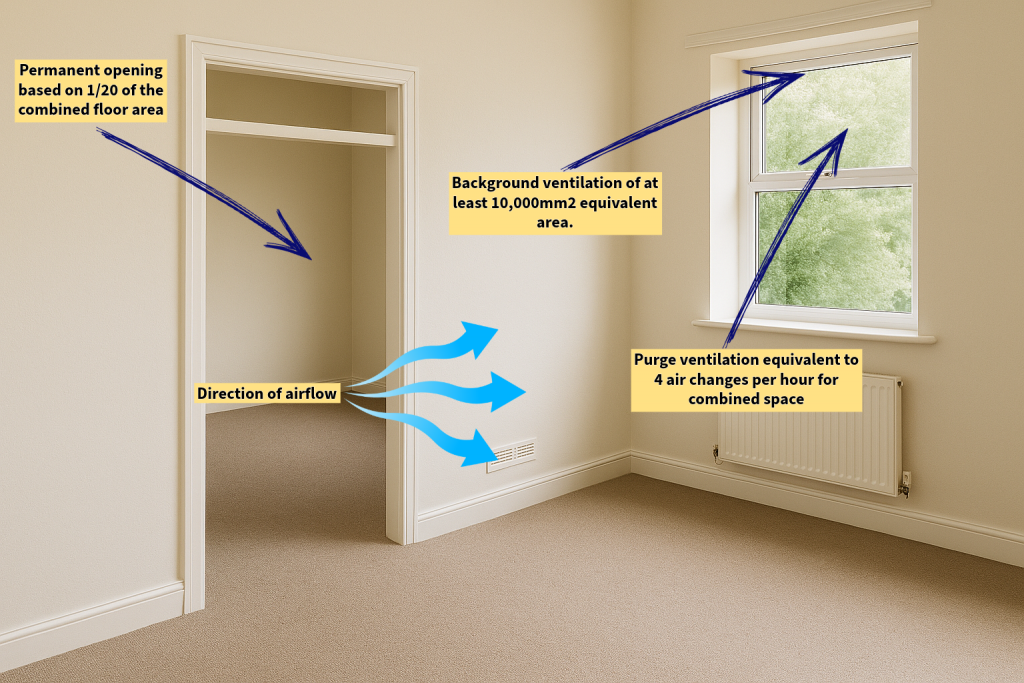
An inner room is any habitable room that relies on another room (the outer room) to reach the outside environment. Because stale air, humidity, and pollutants can accumulate quickly in unventilated rooms, ADF1 requires that inner rooms are provided with:
- Purge ventilation (rapid air change)
- Background ventilation (continuous fresh air)
- A permanent air transfer opening to the outer room
- Adequate flow path from the inner room → outer room → outdoors
These requirements ensure the inner room meets the same air‑quality standards as a room with its own window.
🌬️ 2. ADF1 Requirements for Ventilation Through Another Room
According to ADF1:
✔ Purge Ventilation
Must achieve 4 air changes per hour in each habitable room.
This can be provided by:
- An openable window in the outer room, or
- Mechanical extract ventilation
ADF1 also states the minimum window free‑area needed for purge ventilation:
- ≥30° opening → opening must be 1/20 of floor area
- 15–30° opening → opening must be 1/10 of floor area
These values refer to the combined floor area of the inner + outer room.
✔ Background Ventilation
Where ventilation is provided through another room, the outer room must contain:
- A 10,000 mm² equivalent area background ventilator
✔ Permanent Opening Between Rooms
ADF1 requires:
- A fixed opening between the rooms equal to
1/20 of the combined floor area
This ensures transfer air reaches the purge window or mechanical extract.
📐 3. Example Calculation for Ventilation Through Another Room
Inner room: 12 m²
Outer room: 10 m²
Combined area: 22 m²
Purge opening required (≥30° opening)
22 ÷ 20 = 1.1 m²
Permanent opening required between rooms
22 ÷ 20 = 1.1 m²
Minimum background ventilator size
10,000 mm² minimum
If background ventilation alone can’t meet these requirements, mechanical ventilation with heat recovery (MVHR) is often a more effective long‑term solution — see our guide to Passivhaus‑standard ventilation design for more detail.